

A puppy is not born on its birthday. It is built, week by week, over about 63 days — nine weeks from breeding to whelping (Concannon, 2011). This page walks you through each week. It is written so the whole family can follow along. If your children want to track a litter as a learning project, each week has a simple activity to do together.
Every date below is approximate. Real litters run a few days early or late, and that is normal (Lopate, 2008).
Week 1 (Days 1–7): The Journey Begins
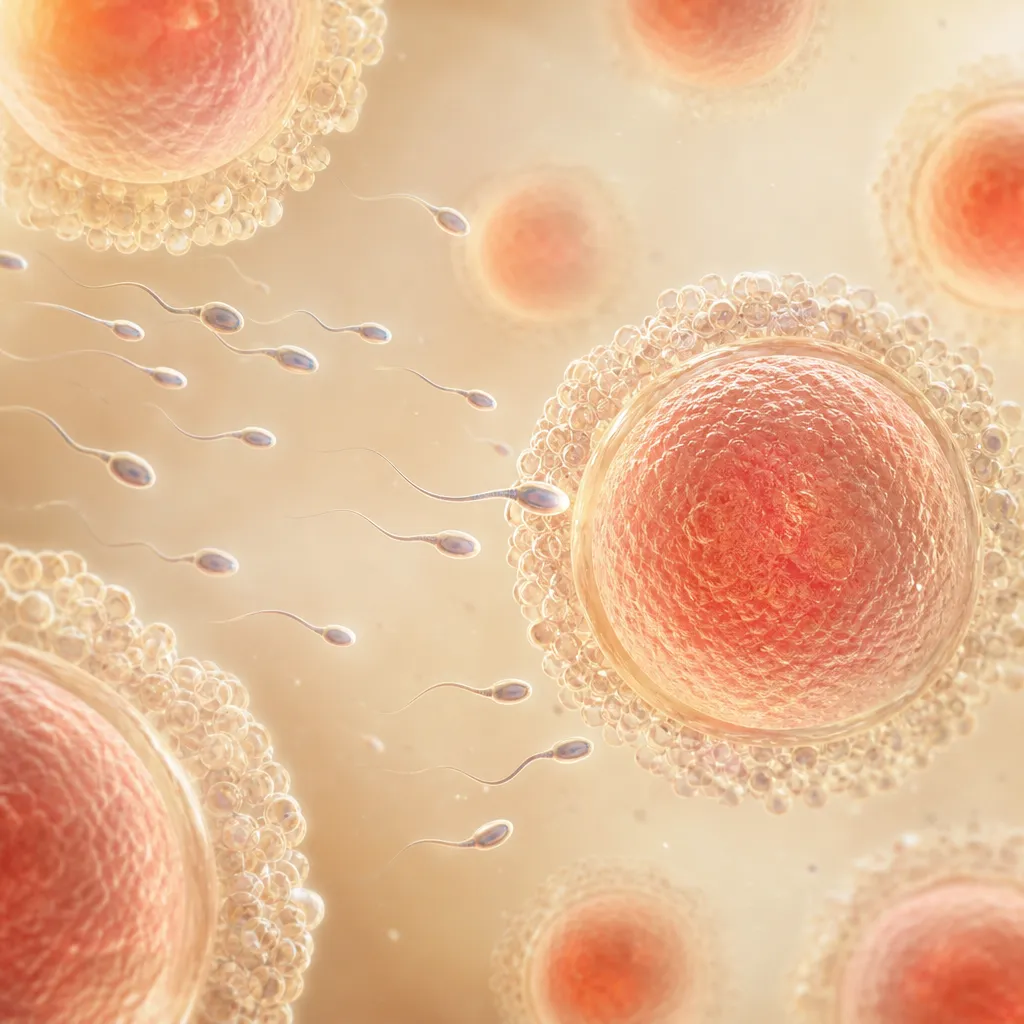
What is happening: After breeding, the father’s sperm travels to meet the mother’s eggs. Dogs have a quirk almost no other animal has: the eggs are released before they are ready, and they need two to three more days to mature before they can be fertilized (Concannon, 2011). So even week one is a waiting game. Once fertilized, each egg starts dividing — one cell becomes two, two become four.
What we do: Nothing changes for mom. Normal food, normal walks, normal love. She does not know yet, and neither do we — there is no test this early.
Family activity: Start a countdown calendar. Mark 63 days from the breeding date and color in one square each day. Guess the whelping date as a family.
Week 2 (Days 8–14): Floating Free
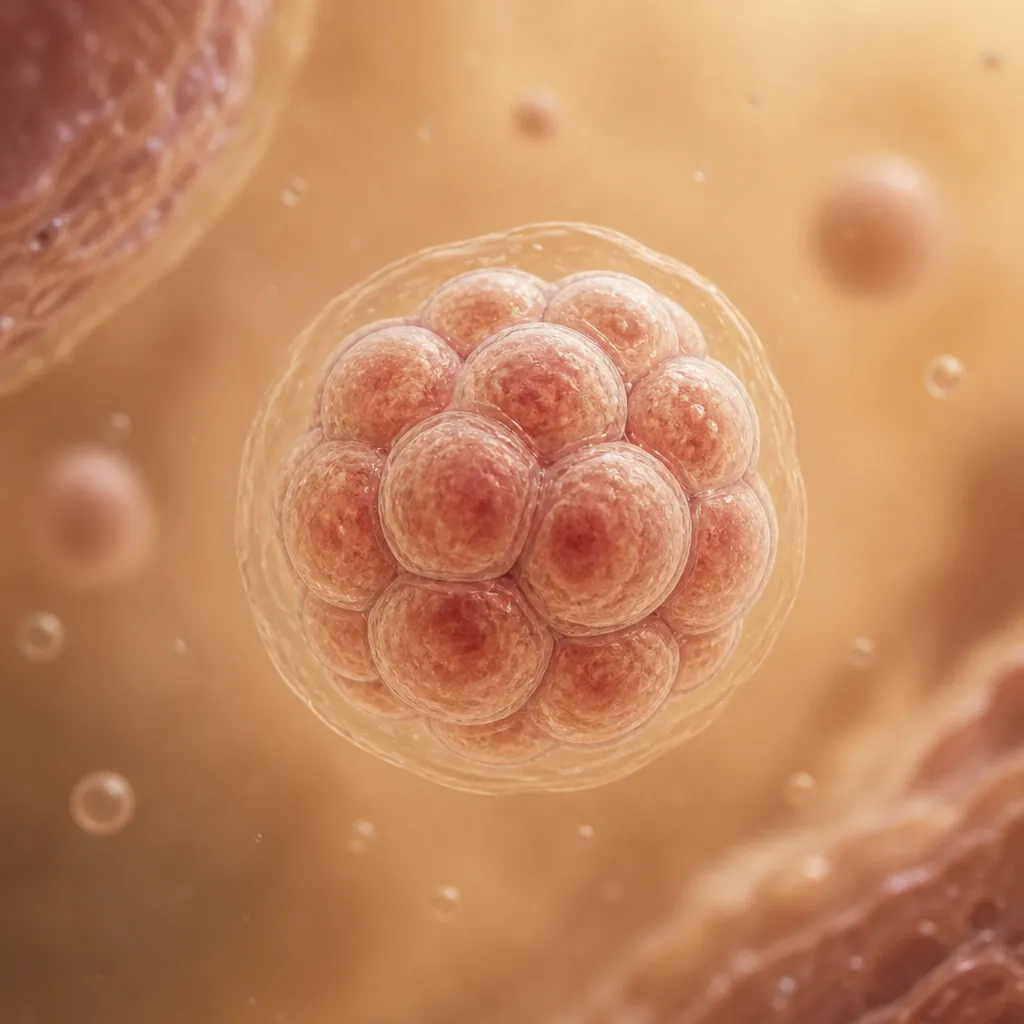
What is happening: The tiny embryos — each smaller than a grain of sand — drift down into the uterus. They are not attached yet. They float, dividing and growing, spacing themselves out along the two horns of the uterus (Pretzer, 2008).
What we do: Still normal routine. We keep mom’s exercise gentle and her stress low.
Family activity: Pour a pinch of salt into your hand. One grain is about the size of each embryo right now. Count out a guess of how many puppies there might be.
Week 3 (Days 15–21): Landing
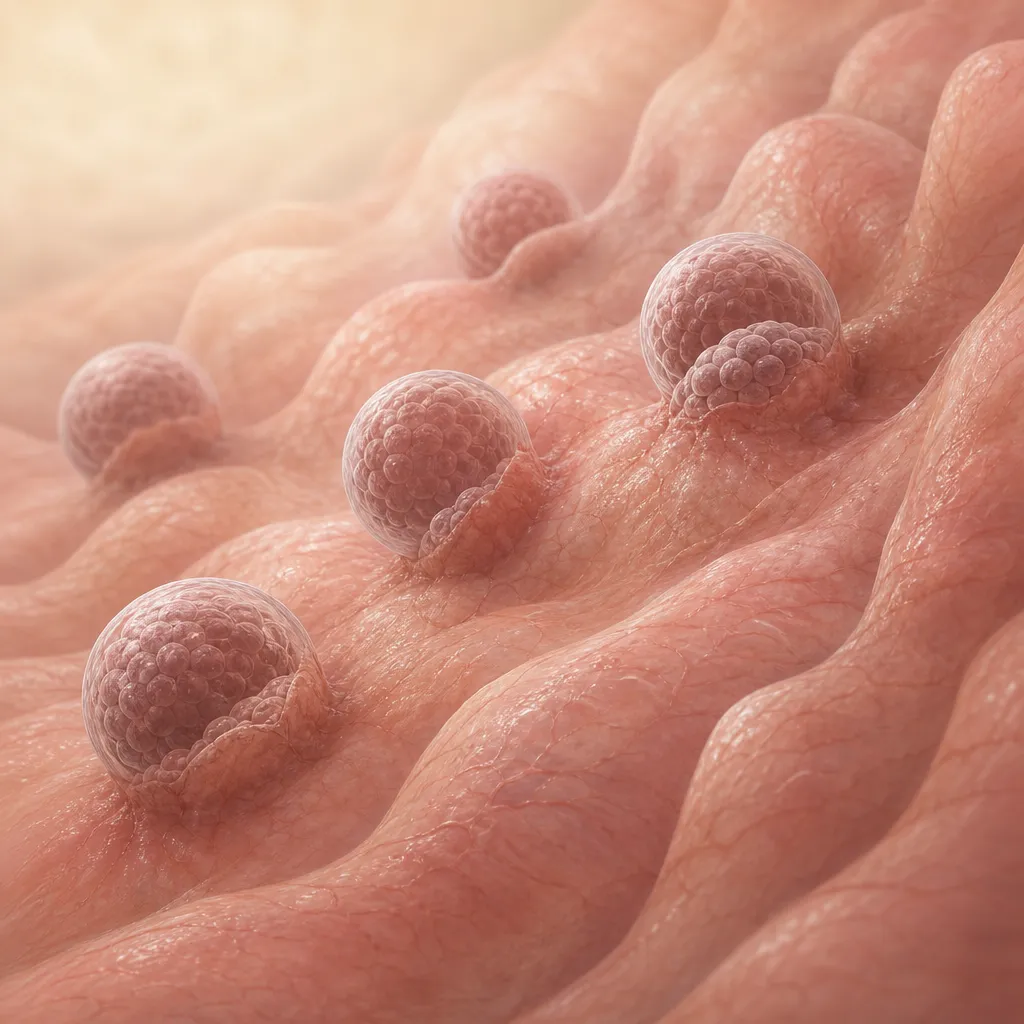
What is happening: Around day 16 to 18, each embryo attaches to the wall of the uterus. This is called implantation (Pretzer, 2008). From now on, mom feeds the puppies directly through her body. Some mothers get a little queasy or picky about food for a few days, like morning sickness.
What we do: We note any appetite change and keep meals small and tasty. No new medicines or supplements without the vet’s okay — the next two weeks are the most sensitive building weeks.
Family activity: Each embryo is now about the size of a small pea. Line up a pea, a blueberry, and a walnut — you will use them as size markers over the next weeks.
Week 4 (Days 22–28): A Heartbeat
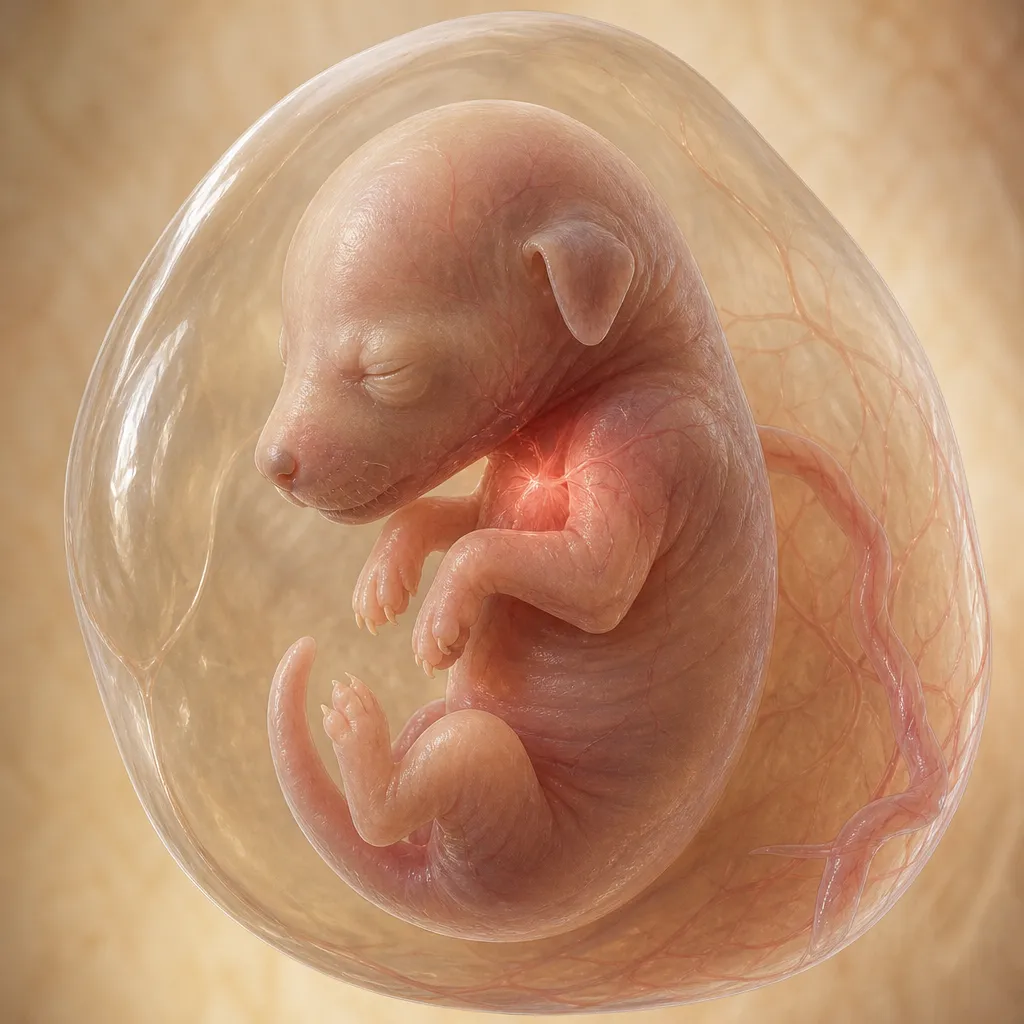
What is happening: This is the biggest building week of all. The head, spine, and organs take shape, and by around day 25 an ultrasound can show tiny beating hearts (Lopate, 2008). Each embryo is roughly blueberry-to-walnut sized by the end of the week. An experienced vet can often feel the little swellings by gentle touch around day 28.
What we do: This is usually ultrasound week — the day we find out the pregnancy is real. We schedule the vet visit and begin planning food increases.
Family activity: Put your hand on your own heart and count beats for one minute. A puppy’s heart beats about twice as fast as yours. Clap the rhythm.
Week 5 (Days 29–35): From Embryo to Puppy
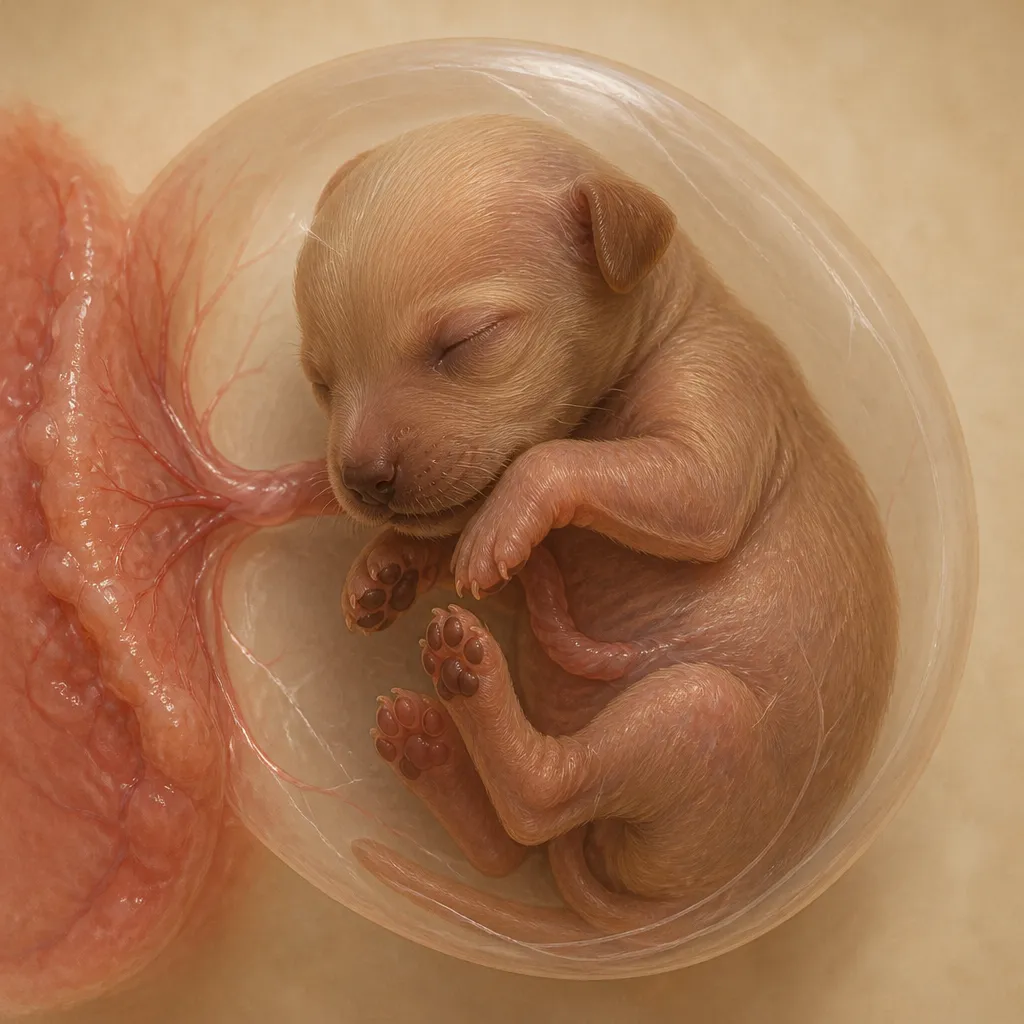
What is happening: Around day 35, scientists stop saying “embryo” and start saying “fetus” (Pretzer, 2008). The big building is done; now it is all growing. Toes form. Whiskers start. The puppies begin to look like tiny dogs.
What we do: We slowly increase mom’s food from this point — a little more each week, with the vet guiding amounts. Short, gentle walks continue.
Family activity: Trace a walnut on paper and draw a curled-up puppy inside it: head, spine, four leg buds, tail. Label the parts.
Week 6 (Days 36–42): Growing Fast
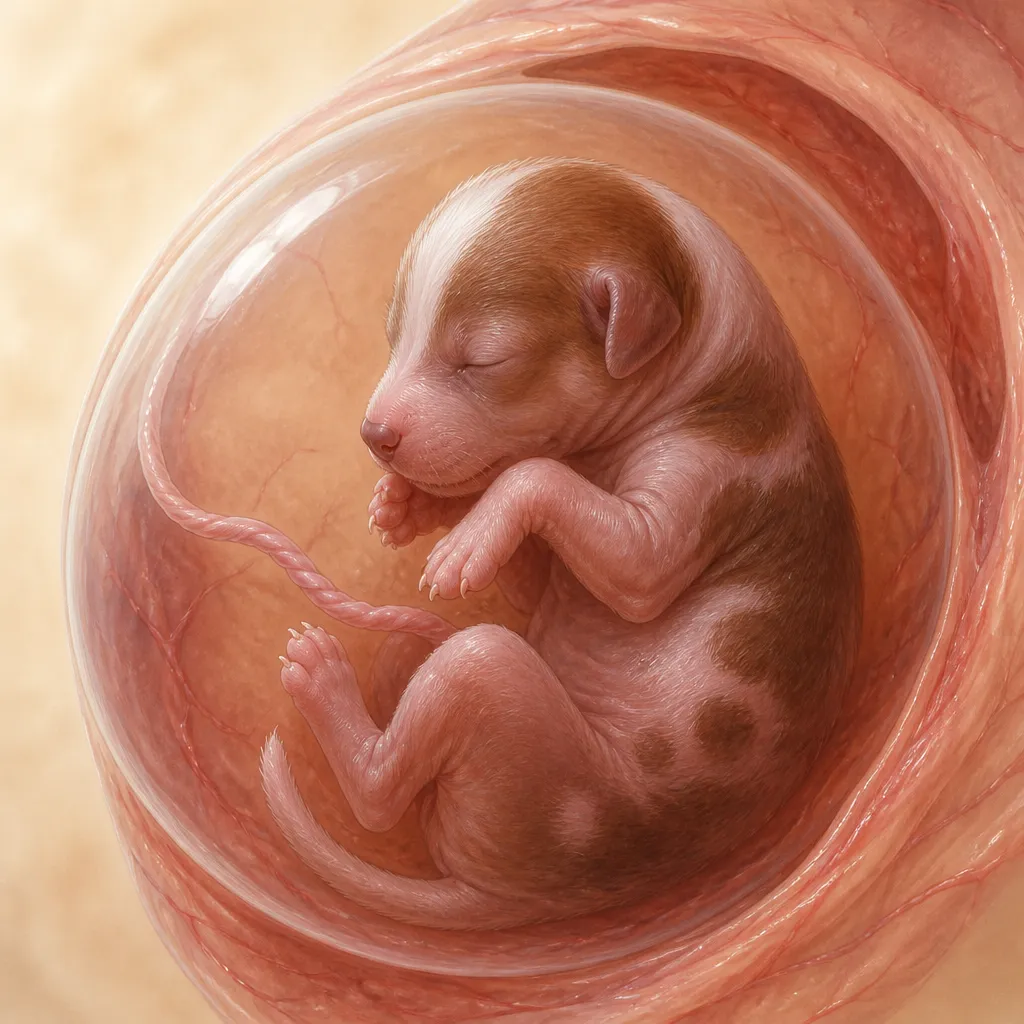
What is happening: The puppies gain size quickly now. Eyelids, claws, and skin pigment develop — the spots a Blenheim Cavalier wears for life are being set right now (Evans & Sack, 1973). Mom’s belly is clearly rounder, and she may slow down on her own.
What we do: Food keeps stepping up, split into smaller meals — the puppies are crowding her stomach. We set up the whelping box now, so it is old news to her long before she needs it.
Family activity: Design a whelping box on paper. What does a dog mom need? Soft bedding, low walls she can step over, a safe rail inside, a quiet corner. Compare your design to ours.
Week 7 (Days 43–49): Bones You Can See
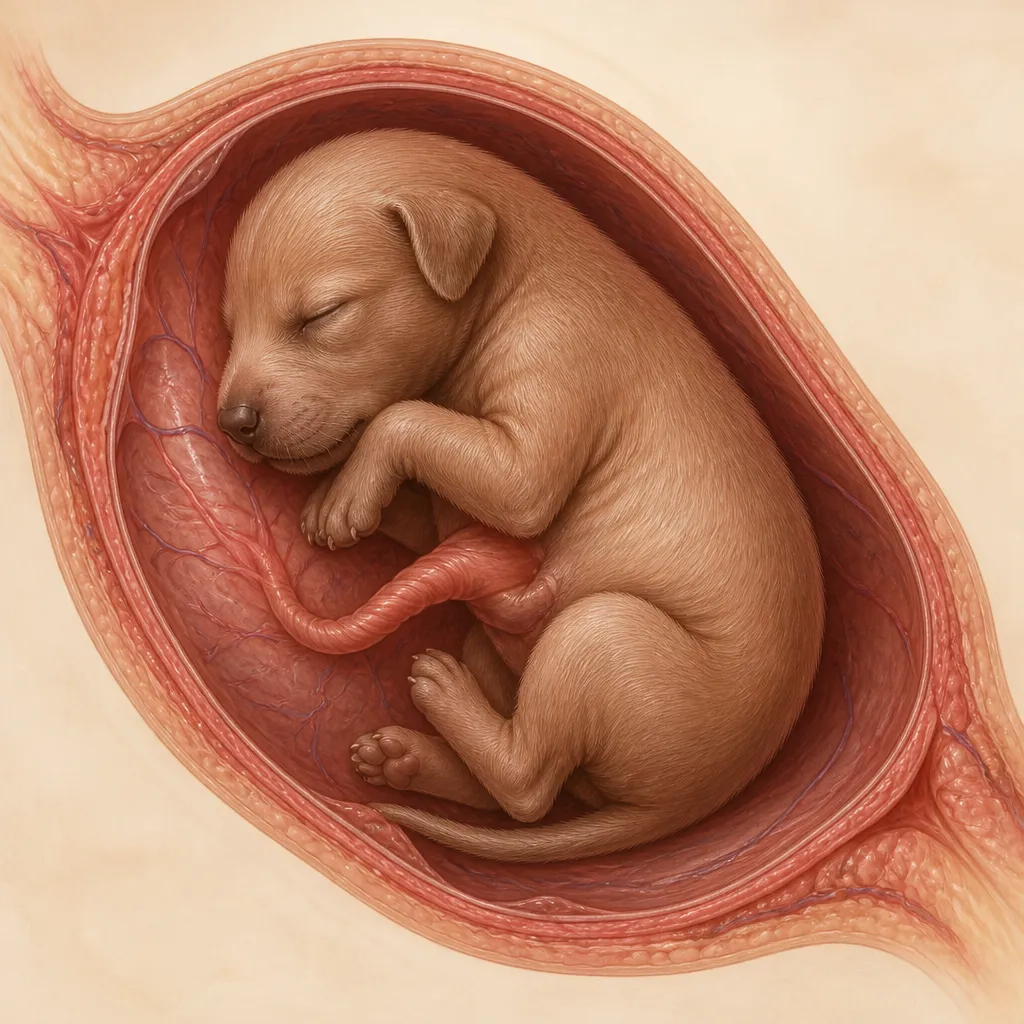
What is happening: The puppies’ skeletons harden with calcium around day 45. That is why an X-ray works from now on — it is the most reliable way to count puppies before birth (Lopate, 2008). Fine fur starts to cover their bodies.
What we do: Many breeders schedule the counting X-ray in this window or the next. Knowing the number matters on whelping night: it tells us when the job is done.
Family activity: Look at your own hand, then at a picture of a dog’s paw skeleton. Count the bones you can find in both. Why do bones need calcium? (It is the same reason you drink milk or eat greens.)
Week 8 (Days 50–56): Almost Ready
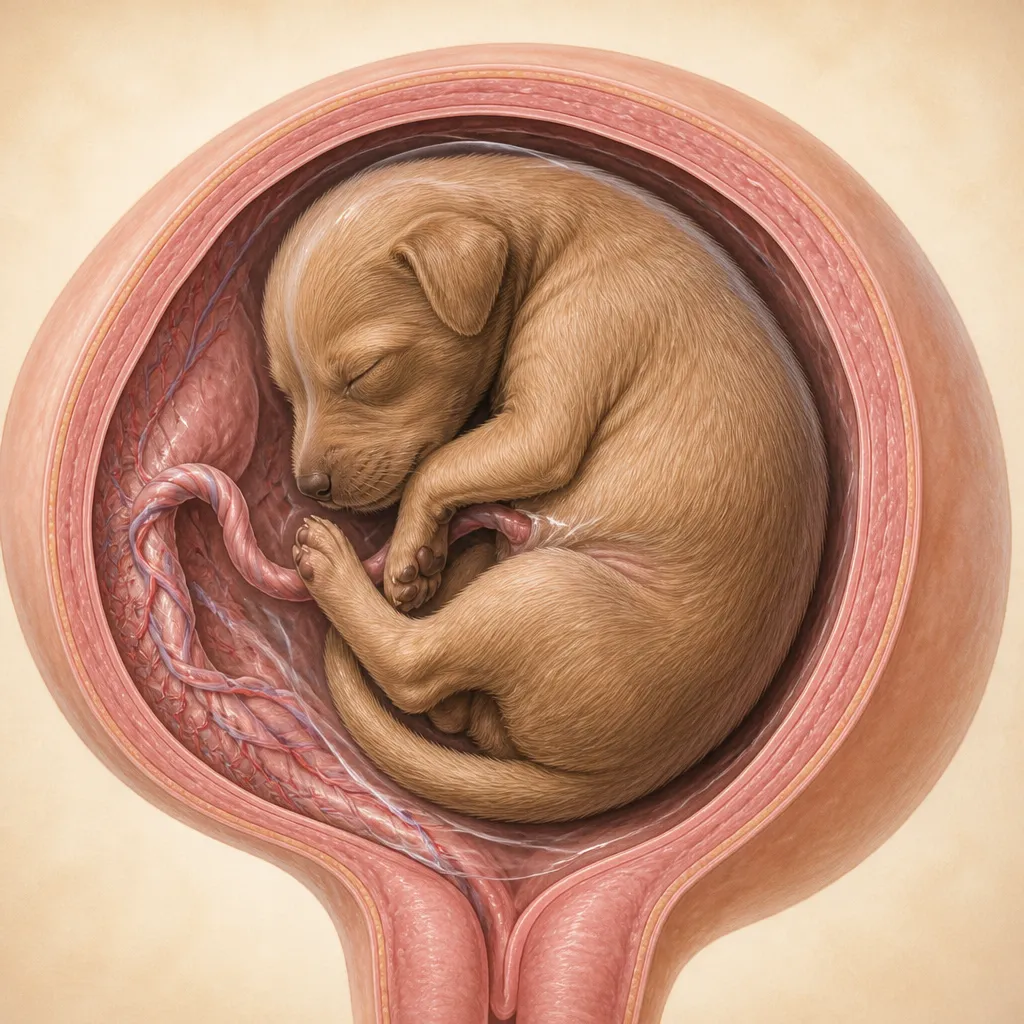
What is happening: The puppies now have full coats and spend their time growing and squirming. Rest your hand gently on mom’s side and you may feel them move. Mom starts “nesting” — digging and arranging bedding. That instinct is thousands of years old.
What we do: The whelping kit gets checked and laid out: clean towels, heat source, scale, vet’s number. We take mom’s temperature at the same times each day to learn her normal.
Family activity: Pack a pretend “go bag” for the puppies’ birth-day. What would a puppy midwife need? Make the list, then check it against ours.
Week 9 (Days 57–63): Whelping Week
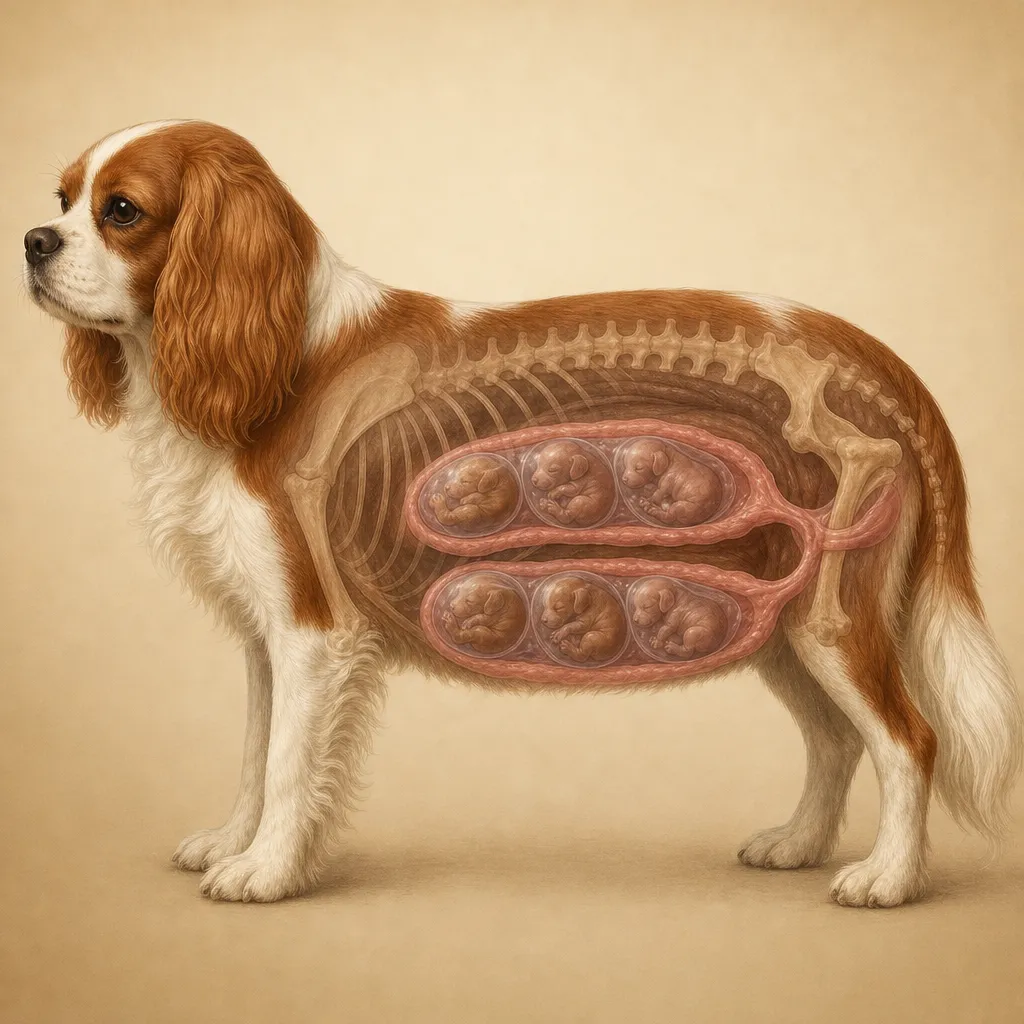
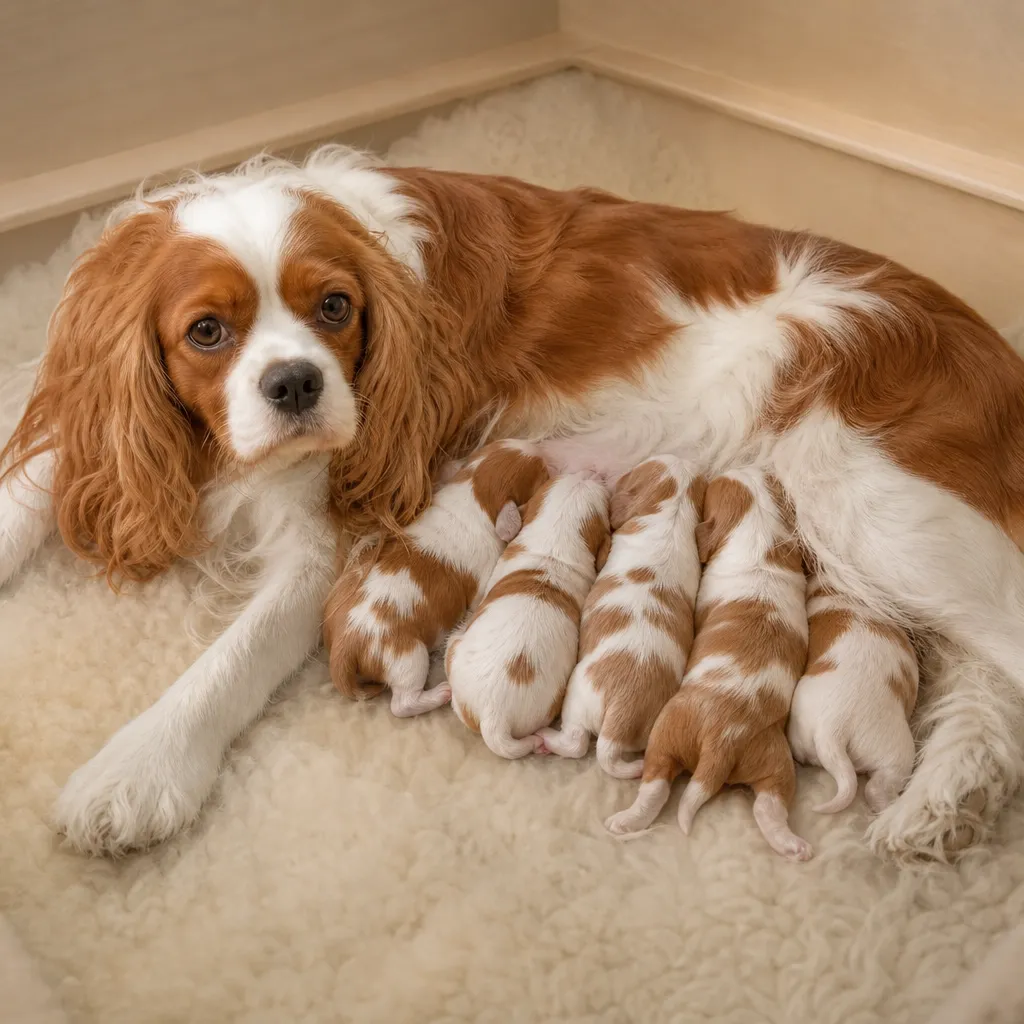
What is happening: Final growth, then the signal: mom’s body temperature usually drops by about one degree within roughly 24 hours of labor (England, 2013). She gets restless, stops eating, and heads for her box. Then, one by one, the puppies arrive — each in its own little sac, each cleaned and warmed by mom within minutes.
What we do: We stay close, stay calm, and mostly let her work. We weigh each puppy at birth, note its color and markings, and make sure everyone finds a nipple. The first milk, called colostrum, carries mom’s immunity to the puppies — every puppy needs it in the first hours.
Family activity: On whelping day, record the facts like a scientist: time of each birth, weight, color, boy or girl. Keep the chart — it is page one of each puppy’s life story.
What Happens After Birth Matters Even More
The nine weeks before birth build the body. The weeks after birth build the mind — that is when socialization, handling, and early training decide what kind of companion a puppy becomes. It is also why we created the Nextgen Jumpstart program: for one family per litter, our puppy stays with us a little longer after the normal go-home age and works through a written foundation checklist — crate, potty routine, handling, name, first manners — before joining your home. If you are following this page with children, Jumpstart’s weekly report cards continue the same kind of learning story after the puppies are born.
Curious where our current litter is on this timeline? Visit the litter page.
Bibliography
-
Concannon, P. W. (2011). “Reproductive cycles of the domestic bitch.” Animal Reproduction Science, 124(3–4), 200–210. doi:10.1016/j.anireprosci.2010.08.028
-
England, G. C. W. (2013). Dog Breeding, Whelping and Puppy Care. Wiley-Blackwell.
-
Evans, H. E., & Sack, W. O. (1973). “Prenatal development of domestic and laboratory mammals: growth curves, external features and selected references.” Anatomia, Histologia, Embryologia, 2(1), 11–45. doi:10.1111/j.1439-0264.1973.tb00253.x
-
Lopate, C. (2008). “Estimation of gestational age and assessment of canine fetal maturation using radiology and ultrasonography: A review.” Theriogenology, 70(3), 397–402. doi:10.1016/j.theriogenology.2008.05.034
-
Pretzer, S. D. (2008). “Canine embryonic and fetal development: A review.” Theriogenology, 70(3), 300–303. doi:10.1016/j.theriogenology.2008.04.029